👉 Jump to the 15 Math Activities for Toddlers and Preschoolers
👉 How to Make Math Part of Everyday Play
You don’t need a closet full of educational toys or complicated activity supplies to help your toddler learn early math. Some of the best math learning can happen during ordinary play with things you already have around the house.
When you hear the words “early math skills,” you might picture flashcards, worksheets, or sitting at the table practicing numbers.
But your toddler doesn’t need a worksheet to start learning math.
Some of the best early math learning can happen while your child is simply playing.
As a former elementary teacher and mom, I know how easy it is to feel like you should be doing more to prepare your child for school. There are so many activities, printables, and educational toys online that it can be hard to know what your child actually needs to learn.
If you’re looking for more simple ways to support learning at home, check out my guide to learning resources for toddlers.
The good news is that you probably already have most of what you need.
Blocks, cars, stuffed animals, puzzles, snacks, and even a trip to the playground can become opportunities to build early math skills.
And you don’t have to turn playtime into a lesson.
For children ages 2–5, the goal isn’t to sit down and complete pages of math problems. It’s to build the foundation that future math skills will grow from through hands-on, meaningful experiences.
In this post, I’ll show you 15 simple math activities for toddlers and preschoolers that build important early math skills using toys and everyday play.
What Math Skills Should Toddlers and Preschoolers Learn?
Before jumping into the activities, it helps to understand what we’re actually trying to build.
Early math isn’t just about knowing how to count to 10 or recognizing numbers.
Children ages 2–5 are beginning to develop skills such as:
- Counting
- Understanding quantities
- Number recognition
- One-to-one correspondence
- Sorting
- Matching
- Identifying shapes
- Recognizing patterns
- Comparing objects
- Understanding size
- Measuring
- Spatial awareness
- Sequencing
- Problem-solving
- Beginning addition and subtraction
These skills develop gradually, and children won’t all master them at the same time.
That’s one reason I love using play.
You can meet your child where they are and build on the skills they’re ready to practice without turning learning into a formal lesson.
15 Math Activities for Toddlers and Preschoolers
1. Count Their Favorite Toys
You don’t need a special counting activity.
Grab a few of your child’s favorite toys and start counting them together.
You could use:
- Toy cars
- Dinosaurs
- Animals
- Blocks
- Dolls
- Stuffed animals
Start with a small number of objects and count them slowly.
As you touch each toy, say the number out loud.
“1…2…3…4.”
Then let your child move each toy into a pile as you count.
For younger toddlers, you can simply count together. As your child gets older, let them take over more of the counting.
The important part isn’t how high they can count. You’re helping them connect number words with actual quantities.
Math skills: Counting, one-to-one correspondence, quantity
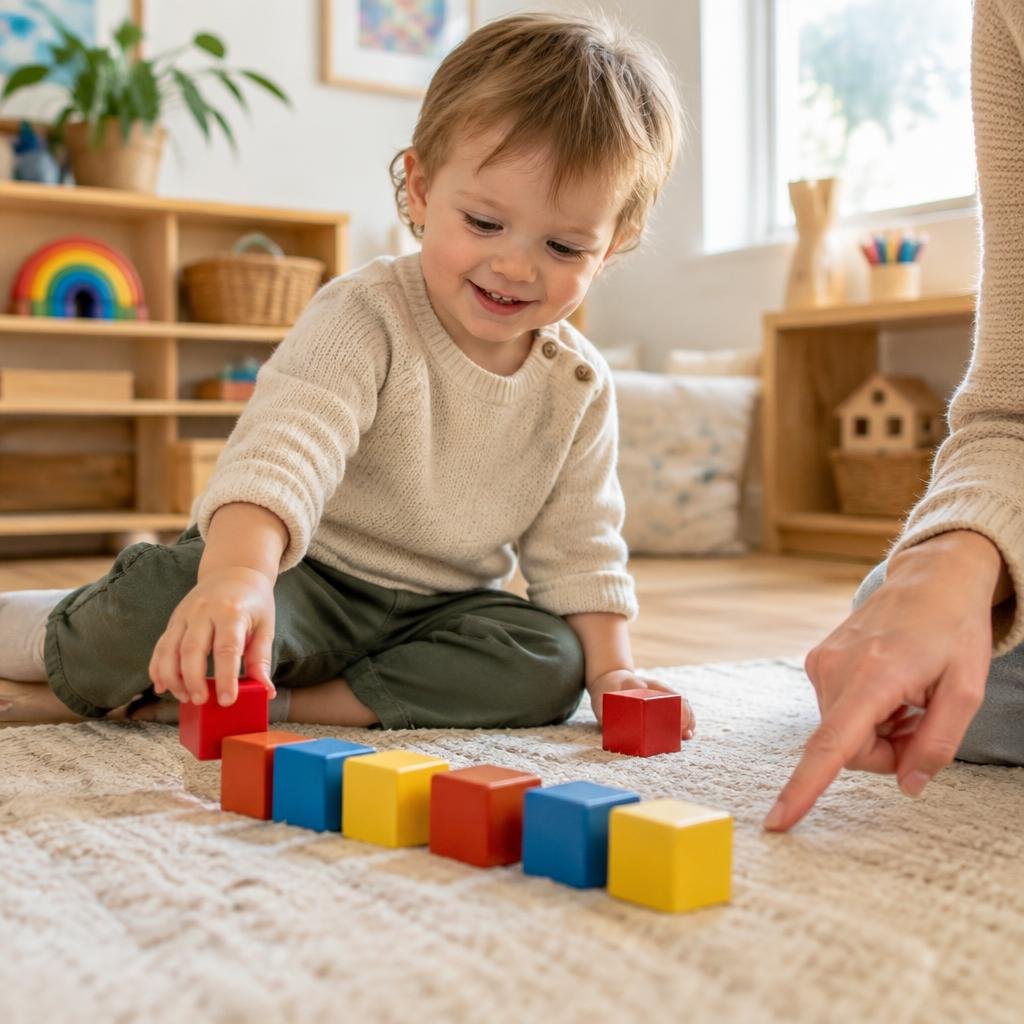
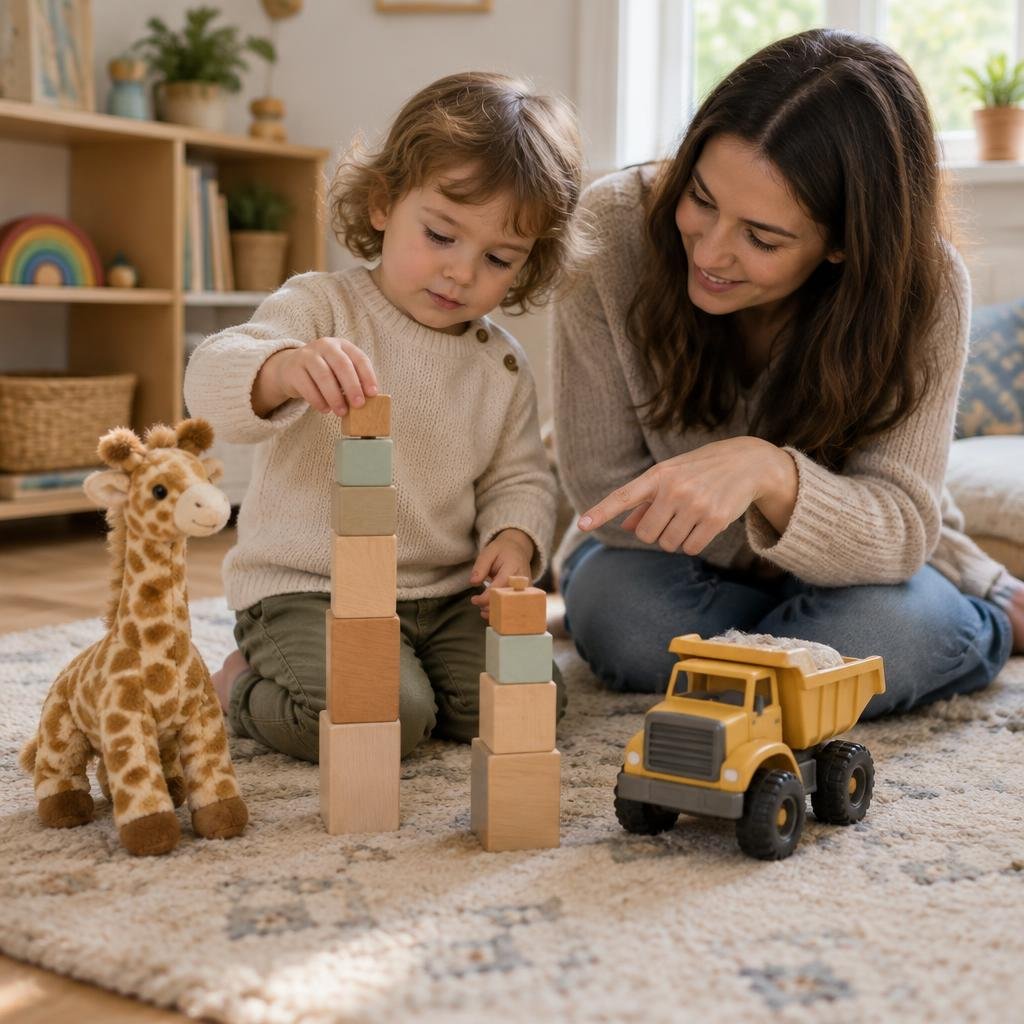
2. Build With Blocks
Blocks are one of my favorite “hidden” math tools because children can learn so much while simply building.
Build a tower together and ask:
“How many blocks tall is your tower?”
Then build another.
“Which tower is taller?”
You can also encourage your child to copy a simple structure you make.
Block play naturally gives children opportunities to practice counting, comparing, shapes, spatial reasoning, and problem-solving.
If you’re looking for more ideas for choosing toys that encourage learning through play, check out my guide to educational toys for toddlers.
You don’t need a room full of specialty toys, either. A simple set of blocks can provide countless opportunities for learning.
Math skills: Counting, comparing, measurement, shapes, spatial reasoning, problem-solving
3. Sort Toys by Color, Size, or Type
Grab a basket of random toys and let your child sort them.
Start with something simple:
“Can you put all the red ones here?”
Then try another attribute:
“Now let’s find all the big ones.”
You can sort toys by:
- Color
- Size
- Shape
- Type
- Texture
Sorting helps children notice how objects are alike and different and begins building an important foundation for classification and logical thinking.
For a younger toddler, you might sort just two groups.
For an older preschooler, challenge them to create their own sorting rule.
Math skills: Sorting, classification, comparing, observation
4. Make Simple Patterns
Patterns are everywhere, and young children can begin noticing them through play.
Start with something simple:
Red → blue → red → blue
Use blocks, cars, toy animals, pom-poms, or anything else you have.
Make the beginning of the pattern and ask:
“What comes next?”
For younger children, simply copy the pattern together.
As your child gets older, encourage them to create their own.
Patterns help children begin recognizing repetition, order, and relationships, all of which become important later in math.
Math skills: Patterns, sequencing, prediction, logical thinking
5. Play “Which Has More?”
Put two groups of toys in front of your child.
For example:
🚗🚗
and
🚗🚗🚗🚗
Ask:
“Which group has more cars?”
Then ask:
“Which has fewer?”
You can also make the groups equal and ask:
“Do they have the same number?”
Physically moving and comparing the objects helps children begin developing an understanding of more, less, and equal.
Math skills: Comparing quantities, more, less, equal
6. Go on a Shape Hunt
You don’t need a shape worksheet to practice shapes.
Instead, go on a shape hunt around your house.
“Can you find something shaped like a circle?”
Your child might find a plate, clock, ball, or toy.
Then look for:
- Circles
- Squares
- Rectangles
- Triangles
Take your shape hunt outside and look for shapes in your neighborhood or at the playground.
Connecting shapes to real objects helps children understand that shapes aren’t just something they see on a worksheet.
Math skills: Shape recognition, visual discrimination, observation
7. Turn Snack Time Into Math Time
Snack time is an easy opportunity for math learning.
Give your child a small number of crackers, berries, cereal pieces, or another snack and count them together.
“Let’s count your crackers.”
Then try:
“You have five. What happens if you eat one?”
Now you’re introducing the beginning of addition and subtraction in a way your child can actually see.
For younger children, keep it concrete.
They can physically see what happens when something is added or taken away.
Math skills: Counting, quantity, addition, subtraction
8. Measure With Toys
You don’t need a ruler or fancy measuring tools to introduce measurement.
Use blocks.
“How many blocks long is your car?”
Or compare two objects:
“Which one is longer?”
You can also use cups during water play.
“Which cup holds more?”
Children are naturally curious about size and quantity, making everyday play a great opportunity to introduce measurement.
Math skills: Measurement, comparing, size, quantity
9. Create a Pretend Toy Store
Turn your child’s toys into a pretend store.
Give each item a simple “price.”
“This car costs three blocks.”
Your child can use blocks, play money, or another safe object to “pay.”
You don’t need to teach actual money skills yet.
Instead, you’re giving your child a meaningful reason to count and think about quantities.
Pretend play also makes math feel purposeful because children are using numbers as part of a game.
Math skills: Counting, quantity, number recognition, problem-solving
10. Explore Shapes With Puzzles
Puzzles can build early math skills without looking like a math activity at all.
Shape puzzles are especially useful because children have to pay attention to:
- Shape
- Size
- Position
- Orientation
Instead of immediately showing your child where a piece belongs, give them time to figure it out.
“Hmm…where do you think that one goes?”
That little moment of thinking and trying different possibilities is valuable problem-solving practice.
Math skills: Shapes, spatial reasoning, problem-solving, visual discrimination
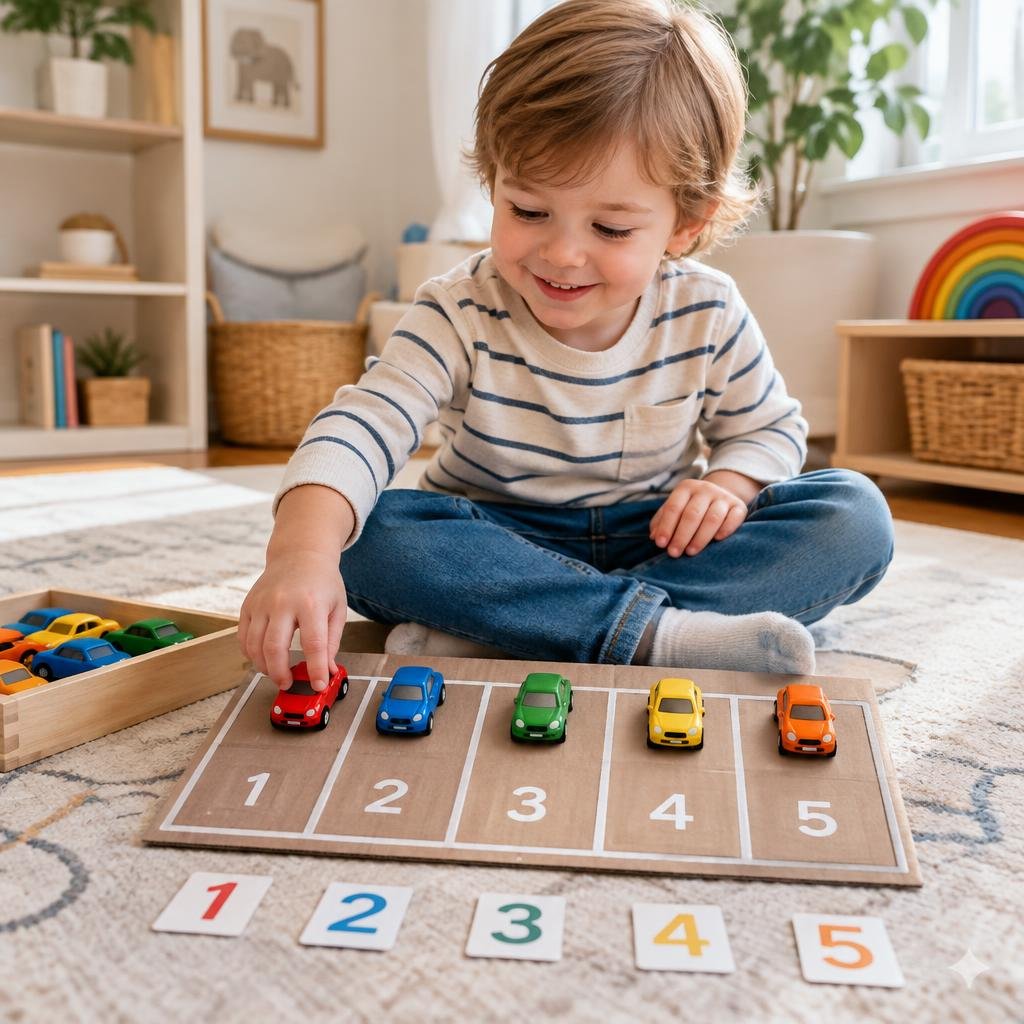
11. Build a Number Road With Cars
If your child loves cars, use that interest to practice numbers.
Write numbers on pieces of paper and create a “road” for the cars.
Your child can drive the car to number 1, then number 2, then number 3.
For a younger child, focus on counting.
For an older preschooler, ask:
“Can you drive to number 5?”
Or:
“What number comes after 4?”
This helps connect number symbols with counting and sequence.
Math skills: Number recognition, counting, sequencing
12. Line Up Toys From Smallest to Biggest
Grab several objects and put them in a random pile.
Then ask your child to arrange them from smallest to biggest.
You could use:
- Stuffed animals
- Blocks
- Cups
- Toy cars
- Balls
Talk about what you’re noticing:
“This one is bigger than this one.”
“This one is the smallest.”
You can also reverse it and arrange them from biggest to smallest.
This helps children practice comparing and ordering objects.
Math skills: Size, comparison, ordering, measurement
13. Play “How Many?”
Put a few objects into a container.
Let your child pull them out one at a time and count them.
As they become more comfortable, ask:
“How many do you have?”
“Can you give me three?”
“Can you find five?”
You can adjust the number based on your child’s age and current skills.
For younger children, don’t worry if they don’t answer correctly every time.
Repeated hands-on experiences with quantities are what matter.
Math skills: Counting, quantity, number sense
14. Find Math in Everyday Routines
Some of the best math activities don’t look like activities at all.
You can practice math while:
- Setting the table
- Putting away laundry
- Cleaning up toys
- Cooking
- Getting dressed
- Walking outside
- Going grocery shopping
Try questions like:
“We need three forks. Can you bring me three?”
“Can you put one sock with each shoe?”
“We have two apples. Should we get two more?”
“How many plates do we need?”
These everyday moments help children understand that math is something we use in real life, not just something we do at a table.
Math skills: Counting, matching, quantity, measurement, problem-solving
15. Let Your Child Lead the Play
This might be my favorite one.
Instead of always planning a specific math activity, watch what your child is already doing and look for the math hiding inside it.
If they’re building a tower:
“How many blocks did you use?”
If they’re lining up cars:
“Which car is first? Which one is last?”
If they’re playing with animals:
“Can you put all the small animals together?”
If they’re playing with a pretend kitchen:
“How many plates do we need?”
You don’t have to constantly ask questions, either.
Sometimes simply using mathematical language during play is enough.
The goal isn’t to interrupt your child’s play and turn everything into a lesson.
It’s to notice the learning that’s already happening and gently build on it.
Math skills: Counting, comparison, sorting, sequencing, problem-solving, mathematical language
How to Make Math Part of Everyday Play
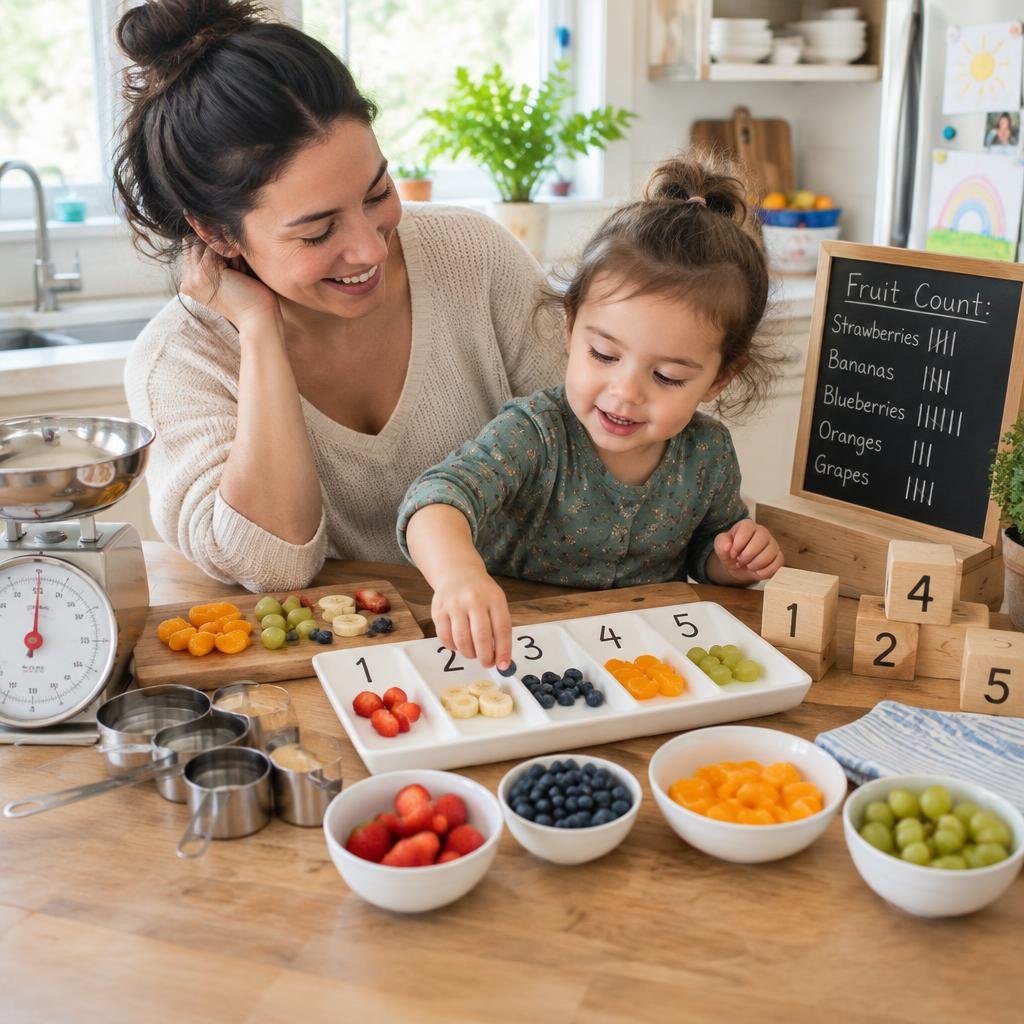
If you’re looking at this list thinking, “Okay, but how am I actually supposed to do all of this?”—don’t worry.
You don’t need to work through all 15 activities.
You don’t even need to plan a math activity every day.
Instead, start looking for little opportunities during the play your child is already doing.
If your child is building, count.
If they’re sorting, talk about colors and sizes.
If they’re playing with cars, practice numbers.
If they’re eating a snack, compare quantities.
If they’re outside, look for shapes.
If they’re cleaning up, sort and count.
This is what makes learning through play so practical.
You’re not adding another thing to your already-full day. You’re learning how to use the moments you’re already having with your child.
If you’re looking for more ways to encourage learning through play, you might also enjoy my guide to independent play and my favorite Montessori toys for toddlers that encourage hands-on learning.
What If My Child Isn’t Interested in “Math”?
Don’t force it.
If your child isn’t interested in counting blocks, try counting cars.
If they don’t want to sort toys, try sorting snacks.
If they don’t care about numbers, follow their interest and look for the math within it.
One of the biggest advantages of learning through play is that you can meet your child where they are.
You can also keep activities very short.
Five minutes of meaningful, hands-on play can be more useful than trying to force a 30-minute “math lesson” when your child has already lost interest.
Your job isn’t to make your child love every activity.
It’s to give them opportunities to explore, practice, and build skills over time.
Final Thoughts
You don’t need to be a math teacher to help your child build a strong foundation in math.
You just need to know what skills you’re building and how to find opportunities to practice them in everyday play.
Count the blocks.
Sort the cars.
Compare the towers.
Look for shapes.
Make a pattern.
Measure with a toy.
Count the crackers at snack time.
Ask questions while you’re playing.
These little moments add up.
And remember, your 2-year-old doesn’t need to be doing what your 4-year-old is doing.
Early math development happens gradually, and play gives you a way to practice these skills at the level that’s right for your child.
The next time your child dumps out a basket of blocks, lines up their cars, or asks you for a snack, look for the math hiding inside that moment.
You may be surprised by just how much learning can happen without a worksheet or a carefully planned activity.
If you’d like more ideas for helping your child learn through play, explore my Learning Resources for Toddlers for more activities, educational toys, apps, and simple resources you can use at home.
Frequently Asked Questions
What are good math activities for toddlers?
Some simple math activities for toddlers include counting toys, sorting objects by color or size, making simple patterns, comparing groups of objects, identifying shapes, and counting during everyday routines. The best activities are hands-on and allow your child to explore math concepts through play.
How can I teach my toddler math through play?
Look for math opportunities in the play your child already enjoys. Count blocks while building, sort cars by color, compare the sizes of stuffed animals, look for shapes around the house, or count snacks during mealtime. You don’t need to turn play into a formal lesson.
What math skills should a 2-year-old know?
At age 2, children are beginning to develop early math concepts such as counting, recognizing small quantities, sorting, matching, comparing sizes, and noticing shapes and patterns. Development varies, so it’s more helpful to provide opportunities for practice than to worry about whether your child can perform a specific skill perfectly.
What math skills should a 3-year-old know?
Many 3-year-olds are developing counting skills, recognizing some numbers, sorting objects, identifying basic shapes, recognizing simple patterns, comparing quantities, and understanding concepts such as big and small or more and less. Hands-on play is a great way to practice these skills.
How can I prepare my preschooler for kindergarten math?
Focus on building a strong foundation rather than trying to teach formal kindergarten math early. Give your child lots of opportunities to count, compare, sort, recognize shapes, make patterns, solve simple problems, and talk about quantities during everyday play.
Do toddlers need worksheets to learn math?
No. Worksheets can be one tool, but young children can develop many early math skills through hands-on play and everyday experiences. Playing with blocks, puzzles, toys, snacks, and household objects can give children meaningful opportunities to explore mathematical concepts.
What toys help toddlers learn math?
Simple toys such as blocks, puzzles, cars, stacking toys, shape sorters, counting objects, and pretend-play materials can all support early math development. You don’t need expensive educational toys. What matters most is how the child interacts with the materials and the opportunities they have to explore mathematical ideas.