Jump to Recommended STEM Toys ↓
Jump to Recommended STEM Activities ↓
When most people hear the word STEM, they often picture complicated science experiments or activities meant for older children. But the truth is, STEM learning can begin much earlier than many parents realize.
For toddlers, STEM is not about memorizing facts or completing worksheets. It is about exploring, asking questions, testing ideas, building, creating, and discovering how the world works.
As a former elementary teacher and a mom, I have always loved activities that encourage children to be curious and think independently. Now that I have toddlers of my own, I see how naturally these skills develop through something children already love to do — play.
The best part is that STEM activities for toddlers do not need to be complicated or expensive. Some of the most meaningful learning moments happen with simple materials you already have at home.
In this guide, I’m sharing easy STEM activities for toddlers that encourage:
- Problem-solving
- Creativity
- Early math skills
- Observation
- Critical thinking
- Confidence through exploration
I’ll also share some of my favorite STEM toys that can help extend learning through hands-on play.
If you’re looking for more ways to support your toddler’s learning through play, check out my complete guide to Best Educational Toys for Toddlers, where I share teacher and mom approved toys that encourage development through play.
What Is STEM for Toddlers?
STEM stands for:
- Science
- Technology
- Engineering
- Mathematics
While those words may sound advanced, toddlers are naturally practicing STEM skills every day.
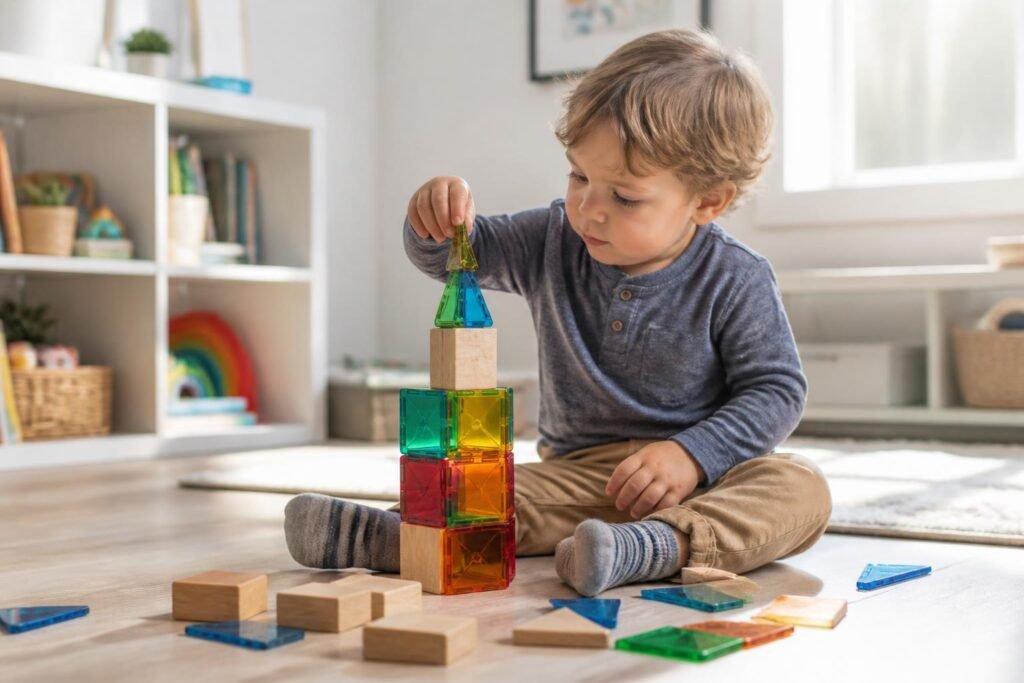
When your toddler stacks blocks and figures out how to make a tower stay standing, they are engineering.
When they mix colors and observe what happens, they are exploring science.
When they sort objects by size or count toys, they are practicing math.
STEM for toddlers is really about encouraging children to ask:
“Why did that happen?”
“What happens if I try this?”
“How can I make this work?”
These simple questions are the foundation of curiosity and problem-solving.
Why STEM Activities Are Important for Toddlers
The toddler years are filled with exploration. Children are constantly testing their environment and learning through hands-on experiences.
STEM activities can help toddlers develop:
Problem-Solving Skills
Instead of being told the answer, STEM activities allow children to experiment and figure things out.
For example, if a block tower falls, your toddler learns to try again and make adjustments.
Creativity
STEM is not just about finding the “right” answer. It encourages children to create, imagine, and come up with their own ideas.
Early Math Skills
Sorting, counting, measuring, comparing, and recognizing patterns all build important math foundations.
Language Development
STEM activities naturally create conversations.
You can ask:
“What do you notice?”
“What do you think will happen?”
“Why do you think it fell?”
Talking through experiences helps children build vocabulary and communication skills.
For more ideas on encouraging communication through play, check out Language Development Activities for Toddlers.
Easy STEM Activities for Toddlers
The best STEM activities for toddlers are simple, hands-on, and open-ended. Remember, the goal is not to create a perfect project. The goal is to let your child explore.
1. Build a Block Tower Challenge
STEM Focus: Engineering
Building with blocks is one of the easiest STEM activities because children naturally experiment with balance, structure, and design.
Try giving your toddler a challenge:
“Can we build the tallest tower?”
“Can we make a house for your animals?”
“What can we do to make it stronger?”
Your child is learning:
- Balance
- Cause and effect
- Spatial awareness
- Problem-solving
Great materials:
Building activities also help strengthen little hands. For more ways to support those skills, explore Fine Motor Skills Activities for Toddlers.
2. Sink or Float Experiment
STEM Focus: Science
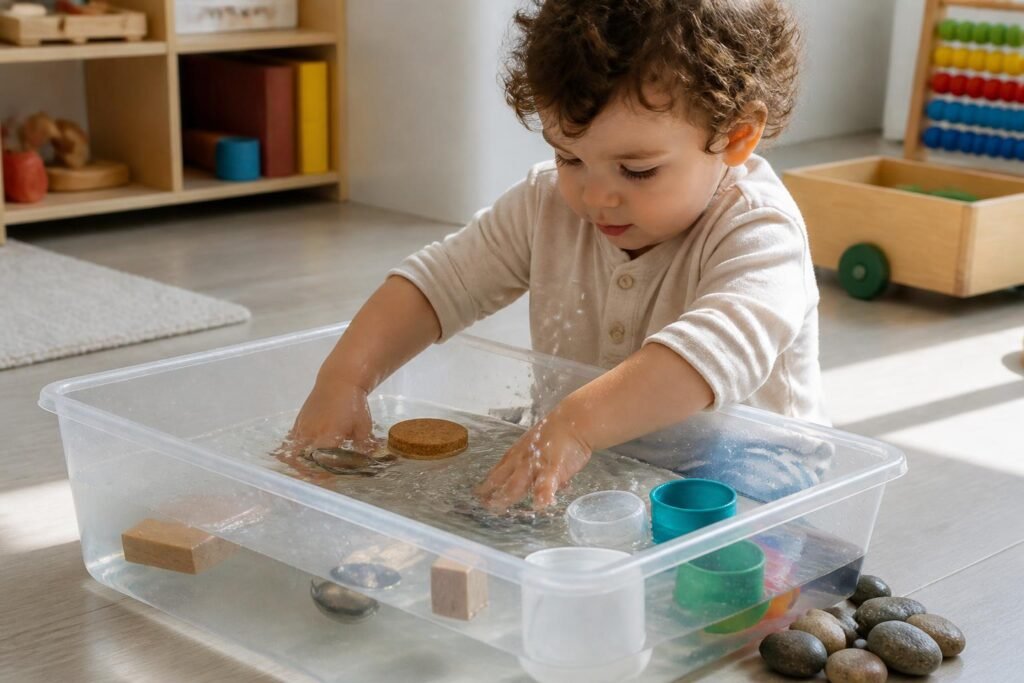
Toddlers love experimenting with water, which makes this a perfect first science activity.
Gather a few safe household objects and ask your child:
“Do you think this will sink or float?”
Place each item in water and observe what happens.
Try objects like:
- A toy animal
- A spoon
- A block
- A leaf
- A ball
Talk about what you notice:
“It stayed on top!”
“It went to the bottom!”
“This one is heavier.”
Your toddler is learning about:
- Observation
- Predictions
- Comparing
- Cause and effect
3. Color Mixing Experiment
STEM Focus: Science
Color mixing is a simple way to introduce toddlers to experimentation.
Using washable paint or colored water, let your child explore what happens when colors combine.
Try questions like:
“What colors do you see?”
“What happens when we mix blue and yellow?”
“What color did we make?”
This activity supports:
- Observation skills
- Vocabulary
- Creativity
- Scientific thinking
Toddlers learn best when they can touch, see, and experience concepts themselves.
4. Build a Ramp for Toy Cars
STEM Focus: Engineering + Physics
Toddlers are naturally fascinated by movement, which makes building ramps a simple and exciting STEM activity.
Use items you already have around the house, such as:
- Cardboard
- Books
- Blocks
- Wooden boards
- Toy tracks
Have your child experiment with different heights and surfaces.
Ask questions like:
“Which car goes faster?”
“What happens if we make the ramp higher?”
“Can we build a ramp that reaches farther?”
Your toddler is learning about:
- Cause and effect
- Gravity
- Speed
- Testing ideas
- Making adjustments
This activity is also a great way to encourage language because your child is explaining what they see and making predictions.
5. Sorting and Counting Activities
STEM Focus: Mathematics
Simple sorting activities are a great introduction to early math skills.
You can use:
- Buttons (with supervision)
- Pom poms
- Toy animals
- Blocks
- Kitchen items
Ask your child to sort by:
- Color
- Size
- Shape
- Type
Then practice counting:
“How many red blocks do we have?”
“Which group has more?”
“Can we make two equal groups?”
These everyday activities help toddlers begin recognizing patterns, comparing objects, and understanding numbers.
6. Nature Exploration STEM Activity
STEM Focus: Science
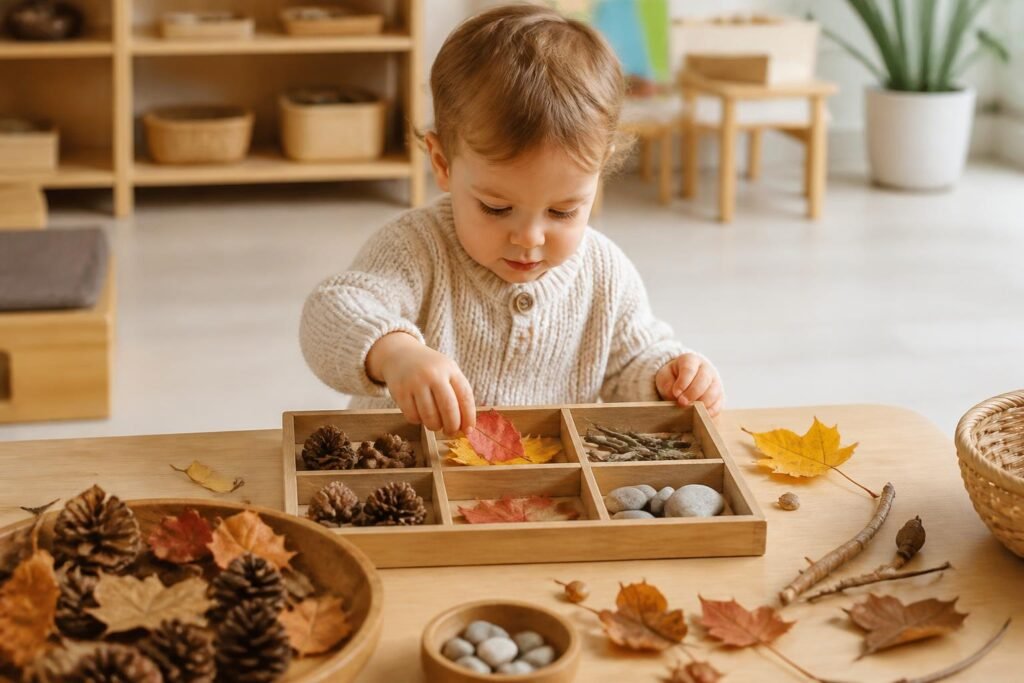
You do not need a classroom to teach science. Nature provides endless opportunities for toddlers to observe and explore.
Go on a simple nature walk and collect safe items like:
- Leaves
- Rocks
- Pinecones
- Flowers
Talk about what you notice:
“Which leaf is bigger?”
“What colors do you see?”
“Is this rock smooth or rough?”
You can also create a simple sorting activity afterward.
This teaches toddlers:
- Observation
- Classification
- Describing
- Curiosity about the world around them
7. Ice Melting Experiment
STEM Focus: Science
This is a simple activity that introduces toddlers to changes in materials.
Place an ice cube in different environments and observe what happens.
Try:
- Ice in the sun
- Ice in the shade
- Ice with warm water
- Ice with salt (with supervision)
Ask:
“What is happening to the ice?”
“Is it getting bigger or smaller?”
“What do you think will happen next?”
Your child is practicing:
- Observation
- Making predictions
- Understanding changes
8. Create Patterns
STEM Focus: Mathematics
Patterns are an important early math skill and can be practiced through everyday play.
Try creating patterns with:
- Blocks
- Stickers
- Beads
- Toys
- Household objects
Examples:
Red block, blue block, red block, blue block.
Ask:
“What comes next?”
“Can you make your own pattern?”
Pattern activities encourage children to notice relationships and predict what happens next.
9. Build With Magnetic Tiles
STEM Focus: Engineering
Magnetic tiles are one of my favorite open-ended STEM toys because toddlers can experiment with building, shapes, balance, and design.
Children can create:
- Towers
- Houses
- Animals
- Bridges
- Roads
The best part is that there is no single correct way to play.
Your child can explore:
“What happens if we add another piece?”
“Can we make it taller?”
“How can we make it stronger?”
10. Simple Kitchen STEM
STEM Focus: Math + Science
Cooking with toddlers is an underrated STEM activity.
While preparing food together, children practice:
- Measuring
- Counting
- Following steps
- Observing changes
Examples:
“How many scoops do we need?”
“What happens when we mix these ingredients?”
“Is the dough soft or hard?”
Cooking also creates wonderful opportunities for language development.
STEM Toys That Encourage Learning Through Play
While activities are a wonderful way to introduce STEM concepts, certain toys can create even more opportunities for exploration.
When choosing STEM toys for toddlers, I look for toys that encourage:
- Creativity
- Problem-solving
- Building
- Experimenting
- Independent thinking
The best STEM toys are not always the ones with the most buttons or instructions. Often, the best toys are the ones that allow children to create something new every time they play.
Magnetic Tiles
Skills Supported:
- Engineering
- Spatial awareness
- Creativity
- Problem-solving
Magnetic tiles allow toddlers to experiment with shapes, balance, and construction.
Building Blocks
Skills Supported:
- Engineering
- Fine motor skills
- Imagination
Simple blocks are one of the most versatile educational toys because children can use them in countless ways.
Puzzles
Skills Supported:
- Problem-solving
- Spatial reasoning
- Focus
Puzzles encourage toddlers to think through challenges and find solutions.
Marble Runs and Construction Sets
Skills Supported:
- Cause and effect
- Planning
- Engineering
Age-appropriate building sets help children explore how things work.
Coding and Logic Toys
Skills Supported:
- Sequencing
- Problem-solving
- Critical thinking
Simple coding toys designed for young children introduce the idea of following steps and creating solutions.
For more educational toy ideas that support your toddler’s development, check out Best Educational Toys for Toddlers.
STEM Toys for Toddlers Comparison Table
| STEM Toy | Skills Supported | Why Toddlers Love It |
|---|---|---|
| Magnetic Tiles | Engineering, creativity, spatial awareness | Toddlers can build endless creations |
| Building Blocks | Problem-solving, fine motor skills, imagination | Simple and open-ended |
| Puzzles | Logic, focus, spatial reasoning | Encourages independent problem-solving |
| Toy Ramps & Tracks | Cause and effect, engineering | Kids love watching things move |
| Sorting Toys | Early math, classification, patterns | Helps toddlers organize and compare |
| Nature Exploration Tools | Science, observation, curiosity | Encourages learning from the world around them |
| Musical Toys | Patterns, cause and effect, creativity | Combines STEM with creativity |
| Coding Toys | Sequencing, logic, critical thinking | Introduces early problem-solving |
How to Choose STEM Toys for Toddlers
When choosing STEM toys for toddlers, remember that the goal is not to make learning feel like school. Toddlers learn best when they are actively exploring and having fun.
Look for toys that:
Encourage Open-Ended Play
The best toys allow children to create, experiment, and come up with their own ideas.
A toy that can be used in many different ways will often hold a child’s interest longer.
Build Problem-Solving Skills
Choose toys that allow your toddler to try, fail, adjust, and try again.
This process builds confidence and resilience.
Encourage Interaction
Some of the best learning happens when parents join in.
Ask questions like:
“What are you building?”
“Why do you think that happened?”
“What should we try next?”
These conversations turn play into meaningful learning experiences.
Frequently Asked Questions About STEM Activities for Toddlers
What are easy STEM activities for toddlers?
Some of the easiest STEM activities for toddlers include:
- Building towers with blocks
- Sink or float experiments
- Color mixing
- Sorting activities
- Nature exploration
- Creating ramps
- Pattern activities
The best activities are simple, hands-on, and encourage curiosity.
Can a 2-year-old do STEM activities?
Absolutely. Toddlers are naturally curious and already practicing STEM skills every day.
STEM activities for 2-year-olds should focus on exploring, experimenting, building, and asking questions rather than completing complicated projects.
Are STEM toys good for toddlers?
STEM toys can be a great addition to toddler play when they encourage creativity, problem-solving, and hands-on exploration.
The best STEM toys are usually open-ended and allow children to experiment instead of simply following instructions.
How do I teach STEM to my toddler at home?
You do not need a formal curriculum to introduce STEM.
You can teach STEM through everyday moments:
- Cooking together
- Building with blocks
- Exploring outside
- Sorting toys
- Asking questions during play
Simple conversations and hands-on experiences are some of the best ways toddlers learn.
What skills do STEM activities help develop?
STEM activities can support:
- Problem-solving
- Creativity
- Early math skills
- Critical thinking
- Observation
- Communication
- Confidence
STEM is about helping children become curious thinkers who enjoy exploring the world around them.
Final Thoughts: STEM Learning Starts With Curiosity
STEM learning for toddlers does not need to involve complicated experiments or expensive materials.
Some of the best learning moments happen when your child is stacking blocks, wondering why something happened, testing an idea, or creating something new.
As a former elementary teacher and a mom, I have learned that children learn best when they are actively involved and excited about what they are doing.
The goal is not to rush toddlers into academics. The goal is to nurture curiosity, creativity, and confidence through play.
Whether you are building a tower, exploring nature, mixing colors, or experimenting with a STEM toy, you are helping your child develop skills that will support them as they grow.
For more ways to support your toddler’s development through play, explore: