Language Development Through Everyday Play
As a former elementary teacher and a mom, I have always known how important language is for learning. Language impacts how children express their needs, connect with others, learn new concepts, and build confidence.
But becoming a mom gave me a completely different perspective.
When my own child experienced a speech delay, I found myself asking many of the same questions so many parents ask:
“Am I doing enough?”
“How can I encourage more communication?”
“What can I do at home to help?”
While I am not a speech therapist, I am a mom who has spent countless hours learning about child development, creating opportunities for communication, and finding ways to encourage language through the thing children do best — play.
One of the biggest things I learned is that language development does not only happen during structured activities. It happens during everyday moments: playing with toys, reading books, pretending, building, singing, and having simple conversations throughout the day.
The best toys and activities are not the ones that do all the talking for your child. The most valuable tools are the ones that encourage interaction, imagination, and connection between you and your child.
In this guide, I’ll share simple language development activities for toddlers, along with toys that can encourage communication, vocabulary growth, creativity, and meaningful play.
If you are looking for more ways to support your toddler’s learning through play, be sure to check out my complete guide to Best Educational Toys for Toddlers, where I share teacher- and mom-approved toys that support development in multiple areas.
What Is Language Development?
Language development is the process children go through as they learn to understand and communicate with others.
This includes much more than saying words. Toddlers are constantly building skills like:
- Understanding what others say
- Learning new vocabulary
- Expressing wants and needs
- Combining words into phrases
- Taking turns during conversations
- Using imagination during pretend play
Every child develops at their own pace, but creating a language-rich environment can give toddlers more opportunities to practice communication skills.
The great thing about play is that it naturally creates these opportunities.
When your child plays, they are not just having fun — they are experimenting, problem-solving, practicing social skills, and learning how to communicate.
How Play Supports Language Development in Toddlers
Children learn best when they are actively involved.
Instead of simply hearing words, toddlers learn when they can connect words to real experiences.
For example:
Instead of saying:
“Car.”
Try expanding the language:
“The red car is going fast!”
or
“The car is driving up the ramp.”
This helps your child hear more vocabulary while connecting words to what they are seeing and doing.
1. Talk During Play (Narrate What Your Child Is Doing)
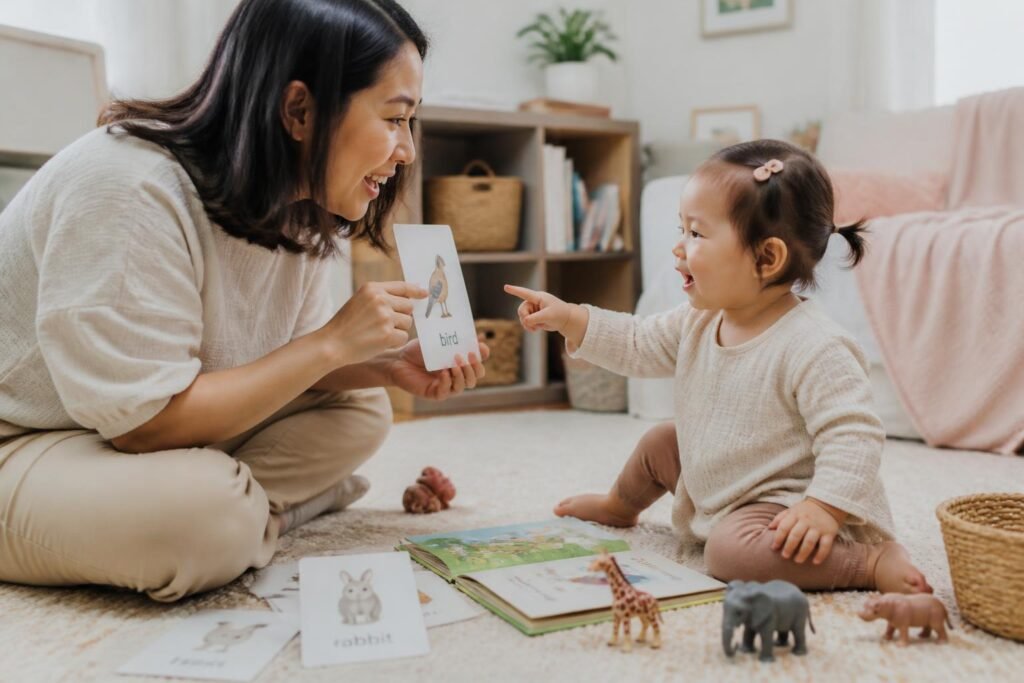
One of the simplest ways to encourage language development is to talk about what your child is already interested in.
You do not need fancy activities or special lessons. Simply describe what is happening.
Examples:
Instead of:
“Good job!”
Try:
“You stacked three blocks!”
“You found the blue piece!”
“You’re feeding the baby doll.”
“You poured the water into the cup.”
These small moments expose children to more words and show them how language connects to their world.
2. Follow Your Child’s Interests
One of the biggest lessons I learned as a teacher is that children learn more when they are interested.
If your toddler loves animals, use that interest.
You can:
- Name animals
- Make animal sounds
- Create pretend stories
- Read animal books
- Talk about where animals live
If your child loves cars:
- Talk about colors
- Describe movement
- Create pretend races
- Build roads together
The goal is not to force communication. The goal is to create moments where communication naturally happens.
3. Ask Open-Ended Questions
Many parents naturally ask questions that can be answered with one word:
“What color is this?”
“What is that?”
Those questions are great, but you can also encourage more language by asking questions that invite your child to think.
Try:
“What do you think will happen?”
“Where should the puppy go?”
“What are you making?”
“Tell me about your picture.”
Even if your child is not answering with many words yet, they are learning from hearing these conversations.
Simple Language Development Activities for Toddlers
The best activities are often the simplest ones because they create opportunities for back-and-forth interaction.
Pretend Play
Pretend play is one of the best ways to encourage language because children naturally practice storytelling and conversation.
Ideas:
- Play kitchen
- Doctor kit
- Baby dolls
- Stuffed animals
- Toy animals
- Grocery store pretend play
Instead of directing the play, join your child and follow their ideas.
You might say:
“What are we cooking?”
“The baby is crying. What does she need?”
“Where should the animals go?”
Pretend play helps toddlers practice vocabulary, emotions, and social communication.
More Language Development Activities for Toddlers
Reading Together
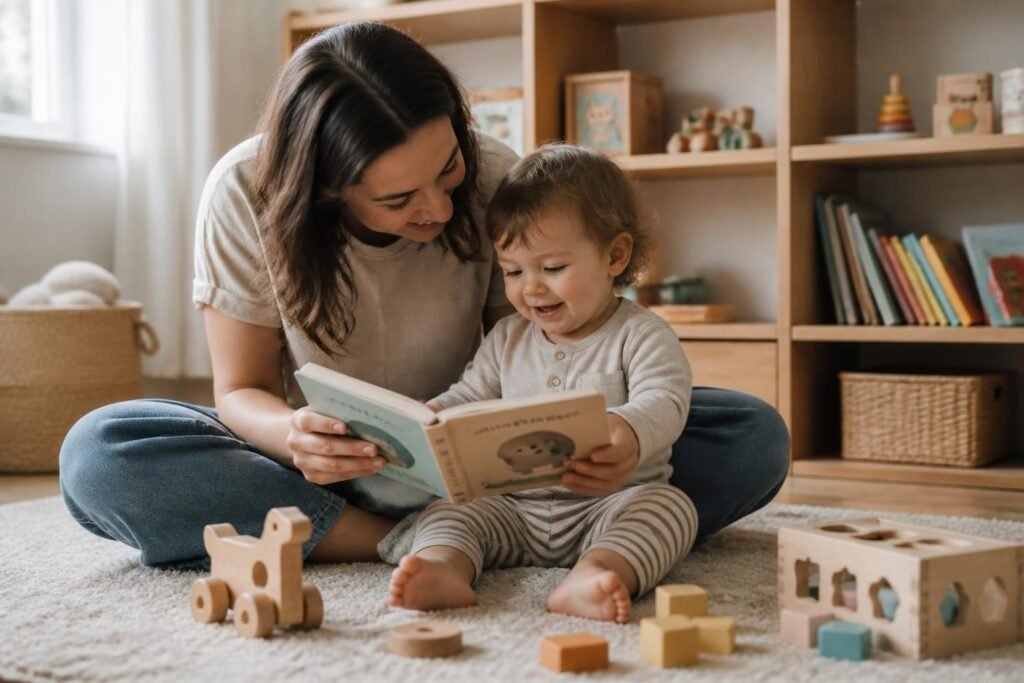
Reading is one of the simplest and most powerful ways to support language development.
You do not have to wait until your child can sit still and listen to an entire story. Even a few minutes of looking at pictures and talking together can create valuable learning opportunities.
Try asking questions like:
- “What do you see?”
- “What is the dog doing?”
- “How do you think they feel?”
- “What do you think happens next?”
You can also pause during familiar books and let your child fill in repeated words or sounds.
Books help toddlers build:
- Vocabulary
- Listening skills
- Storytelling skills
- Imagination
Singing Songs and Nursery Rhymes
Songs are a fun way to encourage language because they combine repetition, rhythm, and movement.
Toddlers love hearing the same songs over and over, and that repetition helps them learn new words.
Try:
- Nursery rhymes
- Movement songs
- Finger plays
- Songs with actions
Examples:
- “Itsy Bitsy Spider”
- “Wheels on the Bus”
- “Old MacDonald”
You can also pause before the last word and give your child a chance to participate.
Sensory Play Conversations
Sensory play is another wonderful opportunity for language growth because children are naturally curious while exploring different textures, materials, and experiences.
While playing, describe what your child is experiencing:
“The rice feels soft.”
“You scooped the blue beads.”
“The water is pouring.”
“You found a hidden animal!”
Sensory activities do not have to be complicated. Everyday items can create opportunities for conversation and discovery.
For more sensory play ideas, check out my guide to: Sensory Activities for Toddlers
Best Language Development Toys for Toddlers
Toys are not a replacement for interaction, but the right toys can create opportunities for conversations, pretend play, and learning.
The best language development toys are usually open-ended toys that encourage children and parents to talk together.
1. ⭐ Amber’s Favorite Pick: Sensory Books
Best For: Vocabulary, storytelling, and conversation
Reading Together
Books are one of my favorite learning tools because they truly grow with your child.
As a mom of two boys, I have seen firsthand how much children can learn through simply sitting together and sharing a story. Books have become one of our favorite parts of the day because they create a special moment of connection while naturally building language skills.
My boys absolutely love books that allow them to participate — whether that means lifting flaps, pointing out pictures, making animal sounds, or hearing the same story over and over again. Those repeated moments are where so much learning happens.
A younger toddler may begin by pointing at pictures, turning pages, and listening to new words. As they grow, they may start naming objects, answering questions, filling in familiar phrases, and eventually retelling parts of the story in their own way.
Reading together is not just about reading every word on the page. It is about creating opportunities for conversation and connection.
Some of our favorite ways to make reading more interactive are:
- Pointing to pictures and naming what we see
- Asking questions like, “What do you think happens next?”
- Letting your child turn the pages
- Making animal sounds or silly voices
- Pausing during repetitive stories and letting your child join in
When choosing books for toddlers, I love looking for:
- Board books – Durable books that can handle little hands exploring
- Interactive books – Books with flaps, textures, sounds, or moving pieces that encourage participation
- Lift-the-flap books – Great for curiosity, attention, and encouraging toddlers to communicate
- Repetitive stories – Books with familiar phrases that help children learn new words and participate in storytelling
Books are one of those simple tools that can have a huge impact. They encourage vocabulary, imagination, listening skills, and connection — all while creating memories together.
Why Parents Love Them:
Books are affordable, easy to use anywhere, and create a special opportunity for connection between parent and child.
2. 🎭 Best Pretend Play Toy: Play Kitchen or Pretend Sets
Best For: Imagination and conversation
Pretend play creates endless opportunities for language.
A simple play kitchen can turn into:
“I’m making dinner.”
“Would you like some soup?”
“The baby needs a snack.”
Children practice vocabulary, storytelling, and social skills during pretend play.
Why Parents Love Them:
Pretend toys encourage children to create their own stories instead of following a single set of instructions.
Montessori-inspired play often focuses on independence, imagination, and hands-on learning. Many Montessori toys encourage children to explore, create, and communicate through meaningful play. If you’re looking for more Montessori-inspired options, check out my guide to 15 Best Montessori Toys for Toddlers, where I share toys that support curiosity, independence, and development through play.
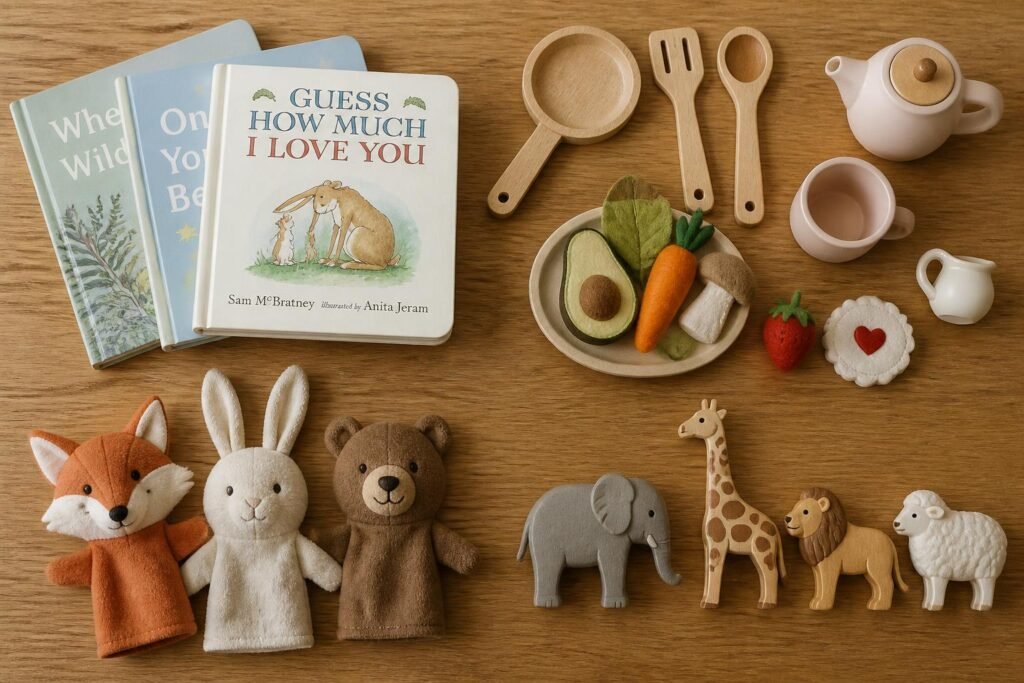
3. 🧸 Best Toy for Imagination: Puppets
Best For: Conversation and storytelling
Puppets can be especially helpful for encouraging shy toddlers to communicate because children often feel comfortable talking through a character.
Try:
- Asking your child what the puppet wants
- Creating silly conversations
- Acting out simple stories
Puppets encourage:
- Vocabulary
- Emotional expression
- Creativity
4. 🐄 Best Animal Toy: Animal Figures
Best For: Early vocabulary and pretend play
Animal figures are simple toys with many learning opportunities.
You can practice:
- Animal names
- Animal sounds
- Colors
- Actions
Examples:
“The cow is walking.”
“The horse is running.”
“The puppy is sleeping.”
As your child grows, these toys become tools for storytelling and imaginative play.
5. 🧩 Best Problem-Solving Toy: Puzzles
Best For: Language + cognitive development
Puzzles are often thought of as just problem-solving toys, but they are also excellent language tools.
While completing puzzles, talk about:
- Colors
- Shapes
- Animals
- Objects
- Locations
Ask:
“Where does this piece go?”
“What do you notice?”
“What animal is this?”
Puzzles also support fine motor development.
For more activities that strengthen little hands, check out: Fine Motor Skills Activities for Toddlers
6. 🧱 Best Open-Ended Toy: Building Toys
Best For: Creativity, problem-solving, and descriptive language
Open-ended building toys are wonderful for encouraging communication because there is no single way to play.
Whether your toddler is stacking blocks, building towers, or creating something imaginary, there are many opportunities for conversation.
Try saying:
“What are you building?”
“How tall can we make it?”
“What should we add next?”
“Tell me about your creation.”
Building toys encourage toddlers to explain their ideas, make choices, and practice using descriptive words.
7. 🎵 Best Musical Toy: Toddler Instruments
Best For: Sounds, rhythm, and language exploration
Music and language development naturally go together. Singing, making sounds, and repeating patterns help toddlers practice listening and communication skills.
Great options include:
- Shakers
- Drums
- Xylophones
- Bells
You can encourage language by asking:
“What sound does it make?”
“Is it loud or quiet?”
“Can you make a fast beat?”
Why Parents Love Them:Musical toys encourage creativity and provide a fun way for toddlers to experiment with sounds and expression.
8. 🔤 Best Early Learning Toy: Alphabet and Letter Toys
Shop some of my favorite alphabet and letter toys on amazon here.
Best For: Early vocabulary and letter awareness
While toddlers do not need formal academics during play, alphabet toys can be a fun way to introduce letters naturally.
The key is keeping it playful.
Instead of quizzing your child, try:
“This is the letter A.”
“Your name starts with A.”
“Can you find another letter?”
Alphabet toys can support:
- Letter recognition
- Vocabulary building
- Early literacy skills
9. 🌈 Best Sensory + Language Toy: Play Dough and Sensory Materials
Shop some of my favorite sensory and playdough sets on amazon here.
Best For: Creativity, describing, and conversation
Sensory materials like play dough provide countless opportunities for language.
While playing, describe:
“The dough is squishy.”
“We rolled a long snake.”
“We made a tiny ball.”
Toddlers learn descriptive words when they experience things firsthand.
You can also encourage pretend play:
“Let’s make a pretend bakery.”
“What should we cook?”
“What ingredients do we need?”
10. ❤️ Best Parent-Child Bonding Toy: Simple Everyday Toys
Best For: Connection and communication
Sometimes the best language development tools are the toys you already have.
A stuffed animal, a set of blocks, toy cars, or even household items can become opportunities for conversation.
The toy itself is not what creates language growth — it is the interaction surrounding the toy.
The most valuable thing you can give your child is your attention, your words, and your willingness to play alongside them.
Language Development Toys Comparison Table
| Toy | Skills Supported | Best For |
|---|---|---|
| Books | Vocabulary, storytelling, listening | Building language skills |
| Pretend Play Sets | Conversation, imagination | Creative communication |
| Puppets | Storytelling, emotional expression | Encouraging talking |
| Animal Figures | Vocabulary, pretend play | Early words |
| Puzzles | Problem-solving, descriptive language | Learning through play |
| Building Toys | Creativity, explanation skills | Open-ended play |
| Musical Toys | Listening, sounds, rhythm | Sound exploration |
| Alphabet Toys | Early literacy, vocabulary | Letter exposure |
| Play Dough | Descriptive words, creativity | Sensory language play |
| Everyday Toys | Connection, communication | Parent-child interaction |
Frequently Asked Questions About Language Development
What activities help with language development in toddlers?
The best activities for language development are activities that encourage interaction and conversation.
Some helpful ideas include:
- Reading together
- Pretend play
- Singing songs
- Sensory play
- Narrating everyday routines
- Playing with open-ended toys
The goal is not to create a lesson but to create more opportunities for your child to hear and use language.
How can I encourage my toddler to talk more?
You can encourage communication by:
- Talking about what your child is doing
- Expanding on their words
- Asking open-ended questions
- Following their interests
- Creating opportunities for back-and-forth interaction
Remember that communication includes gestures, sounds, facial expressions, and attempts to connect—not just spoken words.
Do toys help with speech and language development?
Toys can support language development when they encourage interaction, imagination, and conversation.
A toy by itself does not teach language, but a toy can create the perfect opportunity for parents and children to talk, pretend, and learn together.
What are the best toys for toddlers who are learning to talk?
Some helpful options include:
- Books
- Pretend play toys
- Puppets
- Animal figures
- Puzzles
- Building toys
The best choice is usually a toy that encourages your child to participate and communicate.
When should parents be concerned about language development?
Every child develops differently, but if you have concerns about your child’s communication development, it is always a good idea to talk with your child’s pediatrician or a qualified speech-language professional.
As a mom who has experienced speech concerns, I know how important it is to trust your instincts and seek support when you feel you need it.
Final Thoughts: Language Development Happens Through Connection
Supporting language development does not require expensive toys or complicated activities.
The most powerful learning moments often happen during simple everyday play.
Talking while you build a tower.
Naming animals during pretend play.
Reading the same favorite book again and again.
Singing songs during routines.
These small moments add up.
As a mom and former teacher, I have learned that children learn best when they feel connected, engaged, and encouraged.
Toys can be wonderful tools, but the real magic happens when you join your child in play and create opportunities for communication.
For more ways to support learning through play, explore: